

No minutes to track
Advanced primary care management services
Companian runs the monthly APCM work for your primary care panel. You bill one code, with no minutes to count.
- No new hires. We run outreach, consent and monthly calls.
- One file a month. Nothing is billed until you approve it.
- $0 upfront. Works with your EHR, live in about a week.
$53.78* per patient, every month*APCM level 2 (G0557), 2026 national rate. No time logs.
Get your APCM Plan
Works nationwide
Practices nationwide
You bill under your own NPI
Same Care Advocate every month
RNs, NPs, LCSWs and care companions
Monthly file approved by your team
No new hires needed

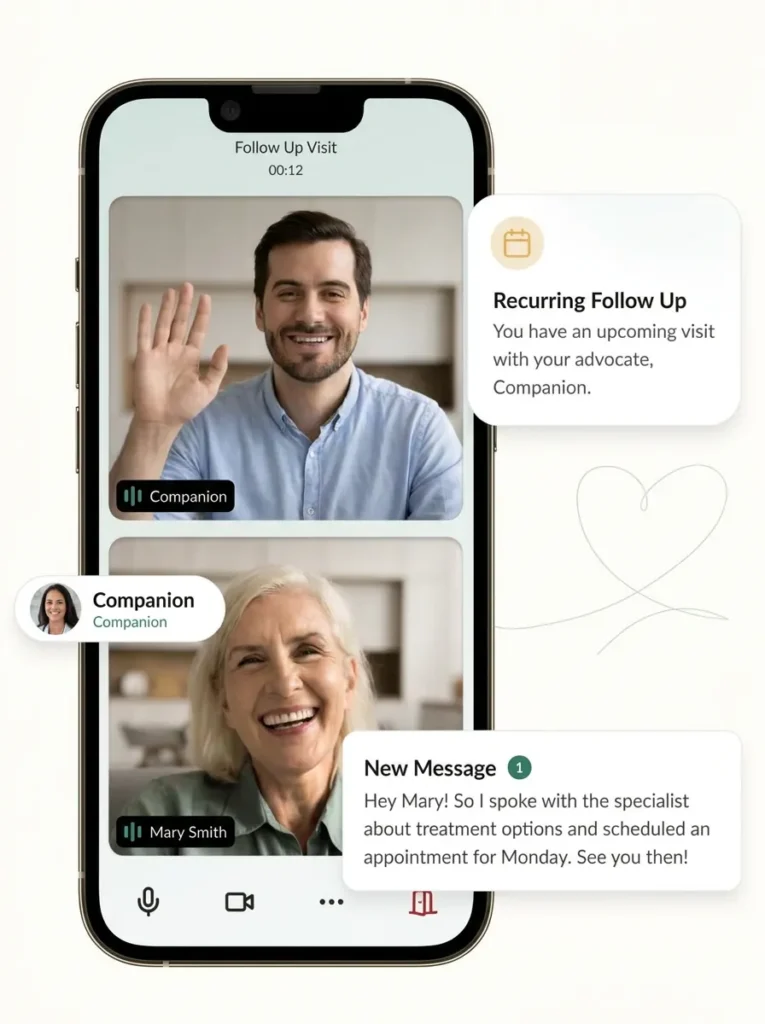

One Care AdvocateSame person, every month
Your NPI, your claimYou bill Medicare directly
Monthly billing fileYour team approves it
No upfront cost to the practice. Your team refers, we handle enrollment, outreach and documentation, and you bill Medicare under your own license. We connect with your EHR in about one week, and have worked with eClinicalWorks, Tebra and athenahealth.
What APCM pays for
CMS rules in effect since January 1, 2025.
Who bills
A physician or non-physician practitioner responsible for all of the patient’s primary care and the continuing focal point for it.
How it is paid
One code per patient per calendar month, with no time threshold. Medicare Part B cost-sharing applies.
Consent
Required once, verbal or written, and documented.
Who can deliver it
Auxiliary personnel may furnish APCM incident to the billing practitioner under general supervision.
Rules summarized from CMS, Advanced Primary Care Management services.

What 400 APCM level 2 patients bring in each month
2026 Medicare-allowed amounts, and the diagnosis codes that qualify.
Example panel
$21,512 / month
$258,144 a year · 400 patients × $53.78 (G0557, national)
- G0557 pays $53.78 per patient-month nationally (2026).
- APCM has no monthly time threshold.
- G0556 covers level 1; G0558 covers QMB patients at level 3.
| Condition | ICD-10 examples | Program fit |
|---|---|---|
| One or no chronic condition | e.g. I10 | Level 1 (G0556) |
| Two or more chronic conditions | e.g. I10 with E11.9 | Level 2 (G0557) |
| QMB with two or more conditions | e.g. E11.9 with N18.31 | Level 3 (G0558) |
| Behavioral health needs | e.g. F32.A | APCM BHI add-on |
APCM levels and 2026 payment
The level follows the patient: chronic conditions and Qualified Medicare Beneficiary status.
| Code | Service | National 2026 |
|---|---|---|
| G0556 | Level 1: one or no chronic conditions | $16.37 |
| G0557 | Level 2: two or more chronic conditions expected to last at least 12 months, with significant risk | $53.78 |
| G0558 | Level 3: a level 2 patient who is a Qualified Medicare Beneficiary (QMB) | $117.24 |
Medicare 2026 national non-facility payment. Find your locality’s amount in the CCM/PCM revenue calculator.
Since January 2026, optional add-ons G0568, G0569 and G0570 cover collaborative care or behavioral health integration. The same practitioner must report the APCM base code that month. Our guide to APCM behavioral health add-on codes covers each one.
Level rules, the 2025 to 2026 changes and what to document are covered in APCM codes G0556, G0557 and G0558.
Who covers each APCM element
Your practice provides them as clinically appropriate. Our scope is agreed per practice.

| Service element (CMS) | Your practice | Companian |
|---|---|---|
| Consent | Keeps the consent on file | Explains APCM and its cost-sharing; documents verbal consent |
| 24/7 access and continuity | Urgent access to the care team at any hour | One Care Advocate per patient, the same person every time |
| Comprehensive care management | Your practitioner assesses and manages | Asks the care-plan questions you assign and records the answers |
| Electronic care plan | Your practitioner writes and updates it | Works from it and routes anything new to your clinicians |
| Care transitions | Follow-up within seven calendar days of discharge | Scope agreed practice by practice |
| Coordination with community services | Links to home- and community-based services | Scope agreed practice by practice |
| Enhanced communication | Patient portal, e-visits | Calls by phone or video |
| Population-level management | Panel-level review of who needs outreach | Scope agreed practice by practice |
| Performance measurement | Stays with your practice | — |
Whatever the scope, the monthly file shows minutes by activity, activities and consent date. Your billing team approves it before any APCM claim.
Choosing between APCM and CCM
One practitioner can’t bill APCM with CCM or TCM for a patient-month.
Consider APCM when
- Your practitioner is the patient’s primary care home
- Some months fall short of 20 minutes of staff time
- The patient is a QMB with two or more chronic conditions
Consider CCM when
- A specialist manages the conditions
- The patient needs 40 minutes or more of staff time in a month
- You want payment to follow the time spent
At national 2026 rates, G0557 ($53.78) pays less than 99490 ($66.13) but has no 20-minute floor. G0558 ($117.24) pays more than 99490 plus 99439 ($116.57).
A worked month across six patients is in APCM vs CCM.
Patients who stay on time-based billing continue in chronic care management with the same Care Advocate.

How APCM support is set up
Scope first, then patients.

Map what you already deliver
We go through the service elements: what your team covers today and what Care Advocates should take on.
Write the scope into the agreement
The services agreement records that scope and the general supervision arrangement. Confirm it with your counsel.
Share the list, approve outreach
Refer by EHR access or referral form, then approve outreach once per patient. Levels stay your billing decision.
Approve the month
Your billing team approves one monthly file. Your practitioner bills one APCM code per patient under the practice’s NPI.
Questions about advanced primary care management services

Can a specialist bill APCM?
APCM is for the practitioner responsible for all of the patient’s primary care. A specialist managing one condition would look at principal care management instead.
What if another practice already bills APCM for the patient?
Only one clinician can report APCM for a patient in a month. Ask at enrollment who the patient sees for primary care.
Can FQHCs and rural health clinics bill APCM?
Yes, according to the CMS APCM FAQ. Health centers are paid the national non-facility amount, not their locality amount: $16.37, $53.78 and $117.24 for the three levels in 2026. More on care management for FQHCs and RHCs.
Can APCM be billed with PIN or CHI?
Yes. CMS allows community health integration and principal illness navigation in addition to other care management when time and effort are not counted twice.
What happens to our current CCM patients?
Nothing changes until your practitioner moves a patient. For that practitioner, each patient-month is billed under APCM or CCM, not both, and the monthly file names the program and code family used.
How is Companian paid for APCM support?
Companian’s fee is walked through on the intro call, once the scope for your practice is clear. Your practice bills Medicare and receives the payment.
Rates & disclosures
National amounts are 2026 Medicare Physician Fee Schedule non-facility payments at the non-QP conversion factor of $33.4009, computed from CMS RVUs. Your amount depends on your Medicare payment locality; see it in the CCM/PCM revenue calculator. Actual payment depends on participation status, place of service and cost-sharing.
Companian supplies Care Advocates and documentation to physician practices nationwide. Companian is not a medical practice and does not bill Medicare. The billing practitioner keeps the care plan, every clinical decision and the claim. Patients pay the usual Medicare Part B deductible and coinsurance for these services unless other coverage pays it.
See whether APCM fits your practice
Fifteen minutes on your panel and the elements you already cover.