
Get paid between visits
Chronic care management for endocrinology practices
Companian keeps your diabetes and thyroid patients on track every month, from refills to follow-ups.
- No new hires. We run outreach, consent and monthly calls.
- One file a month. Nothing is billed until you approve it.
- $0 upfront. Works with your EHR, live in about a week.
$66.13* per patient, every month*Endocrinology CCM, CPT 99490 (2026 national rate)
Get your CCM Plan
Works nationwide
Practices nationwide
You bill under your own NPI
Same Care Advocate every month
RNs, NPs, LCSWs and care companions
Monthly file approved by your team
No new hires needed



One Care AdvocateSame person, every month
Your NPI, your claimYou bill Medicare directly
Monthly billing fileYour team approves it
Endocrine conditions a Care Advocate can follow
Your plan sets the targets. The calls supply the data.
Insulin-treated diabetes
Patients read back meter or sensor numbers against your targets. A low your plan calls urgent triggers your escalation steps.
Thyroid disease
After a dose change, the Care Advocate checks the patient understood it, confirms the follow-up lab date and notes any side effects.
Obesity-related conditions
Each call logs weight against the plan. Questions about weight-management medicines go to your clinicians.
Diabetes complication screening
Annual eye exams, foot exams and kidney labs in your plan are confirmed with the patient and noted in your chart.

What 200 diabetes and thyroid patients bring in each month
2026 Medicare-allowed amounts, and the diagnosis codes that qualify.

Example panel
$13,226 / month
$158,712 a year · 200 patients × $66.13 (CPT 99490, national)
- CPT 99490 pays $66.13 per patient-month nationally (2026).
- Your locality moves it up or down: $60.71 in Arkansas to $83.76 in Alaska.
- Each extra 20 minutes adds CPT 99439 at $50.44.
| Condition | ICD-10 examples | Program fit |
|---|---|---|
| Type 2 diabetes | E11.9, E11.65 | CCM with a second condition; PCM alone |
| Type 1 diabetes | E10.9 | CCM with a second condition |
| Hypothyroidism | E03.9 | CCM with a second condition |
| Hyperlipidemia | E78.5 | CCM with a second condition |
Endocrinology PCM, CCM or APCM: which code is yours
Who manages the diabetes decides which program your practice bills.
| Who manages what | Code family | Who bills it | CMS condition |
|---|---|---|---|
| Your practice manages the diabetes; primary care manages everything else | PCM: 99426, 99427 for staff; 99424, 99425 for the endocrinologist | Your practice, as endocrinology principal care management | One serious, high-risk condition expected to last at least 3 months; nothing paid under 30 minutes a month |
| Your practice manages diabetes and thyroid disease | CCM: 99490, 99439 | Your practice, as endocrinology CCM, if no other practitioner bills CCM that month | Two or more chronic conditions expected to last at least 12 months that place the patient at significant risk |
| One primary care practitioner is responsible for all of the patient’s primary care | APCM: G0556, G0557, G0558 | Primary care, once a month, with no time threshold | APCM, CCM and TCM cannot be billed by the same clinician for the same patient in one month |
| Code | Service | National 2026 |
|---|---|---|
| 99426 | PCM, clinical staff, first 30 min | $67.80 |
| 99427 | PCM, staff, each additional 30 min | $54.11 |
| 99424 | PCM, physician or QHP personally, first 30 min | $87.51 |
| 99490 | CCM, clinical staff, first 20 min | $66.13 |
| 99439 | CCM, staff, each additional 20 min | $50.44 |
Compare the two monthly models in APCM vs CCM.

How chronic care management for endocrinology practices runs
Your office approves; the Care Advocate calls, records and files.
Choose the patients
Share the list through EHR access or a short referral form. You pick which diabetes and thyroid patients start first.
Approve each first call
You approve outreach once per patient. The Care Advocate explains the program and cost-sharing, then records verbal consent.
Monthly check-ins
The same Care Advocate asks your plan’s questions, logs reported readings and confirms eye, foot and lab appointments.
One file to approve
It lists patient reference, program and code family, service month, minutes by activity, activities and consent date.

Initiating visits, glucose data and primary care coordination
What CMS asks of chronic care management for endocrinology practices.
Initiating visit and consent
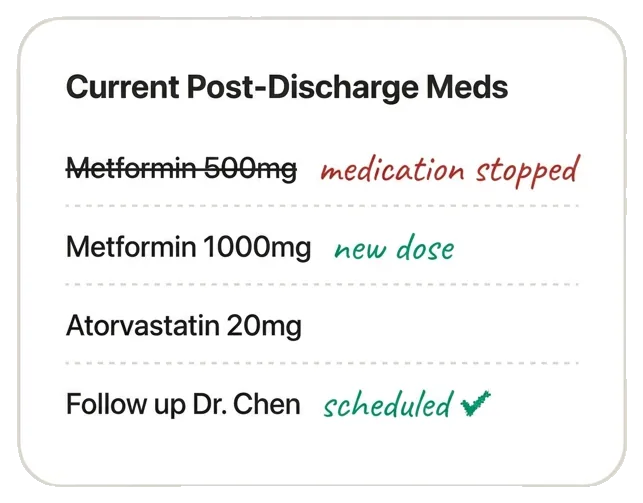
CMS requires an initiating visit only for new patients or those not seen in the prior year. A comprehensive E/M visit, AWV or IPPE counts. Consent can be verbal. The first call covers the one-practitioner-per-month rule and the right to stop. See CCM requirements.
Glucose readings and RPM
CMS lets you bill CCM alongside remote patient monitoring or remote therapeutic monitoring, but not both. New for 2026: 99445 covers 2 to 15 days of device supply; 99470 covers the first 10 minutes of RPM treatment management. Reading time counts under one code only.
Coordinating with the primary care office
Before enrollment, your office confirms which program primary care bills. The answer goes in the monthly file, next to the minutes. If your team is new to the program, start with how chronic care management works for Medicare.
Cost, transport and housing
Cost, a ride or housing can keep a patient from an eye exam or lab draw. After your practitioner’s initiating visit, that work may qualify as community health integration, billed alongside PCM or CCM. No minute counts twice. See CHI codes G0019 to G0022.
Chronic care management for endocrinology
Chronic care management for endocrinology begins with diabetes, which is on CMS’s example list (MLN909188).
- If primary care’s CCM plan addresses diabetes, the endocrinologist cannot bill PCM for diabetes alongside it (CMS CCM FAQ).
- The two practices decide who manages diabetes; the PCM practitioner documents their coordination (CY2020 final rule).
- If diabetes leaves primary care’s CCM plan, that plan still needs two qualifying conditions (MLN909188).

Questions endocrinology practices ask

Can the Care Advocate change an insulin or levothyroxine dose?
No. The Care Advocate records what the patient reports and routes it to your clinicians. Every dose decision stays with your practice.
How much time does a diabetes patient need for 99490?
Twenty minutes of clinical staff time in the calendar month earns 99490, and each further full 20 minutes adds a unit of 99439. See CPT 99439.
Who is on the phone?
Registered nurses, nurse practitioners, licensed clinical social workers and care companions, working remotely. Gloria, an AI assistant, drafts documentation and pre-visit summaries; people make the calls.
Who oversees the Care Advocate’s work?
Your billing practitioner, under the general supervision CMS allows for clinical staff. The services agreement spells out the arrangement; have your counsel confirm it.
Do you work with practices in every state?
Yes. Companian works with physician practices in all 50 states. The tables show national 2026 amounts; the CCM/PCM revenue calculator shows your locality.
What does the service cost the practice?
We walk through our fee on the intro call. Medicare pays your practice directly, under its own NPI.
Rates & disclosures
National amounts are 2026 Medicare Physician Fee Schedule non-facility payments at the non-QP conversion factor of $33.4009, computed from CMS RVUs. Your amount depends on your Medicare payment locality; see it in the CCM/PCM revenue calculator. Actual payment depends on participation status, place of service and cost-sharing.
Companian supplies Care Advocates and documentation to physician practices nationwide. Companian is not a medical practice and does not bill Medicare. The billing practitioner keeps the care plan, every clinical decision and the claim. Patients pay the usual Medicare Part B deductible and coinsurance for these services unless other coverage pays it.
Care management for other specialty practices
The same Care Advocate approach, adapted to each specialty’s conditions.
Add care management to your endocrinology practice
Fifteen minutes on your diabetes and thyroid patients. No patient information needed.