

Get paid between visits
Chronic care management for infectious disease practices
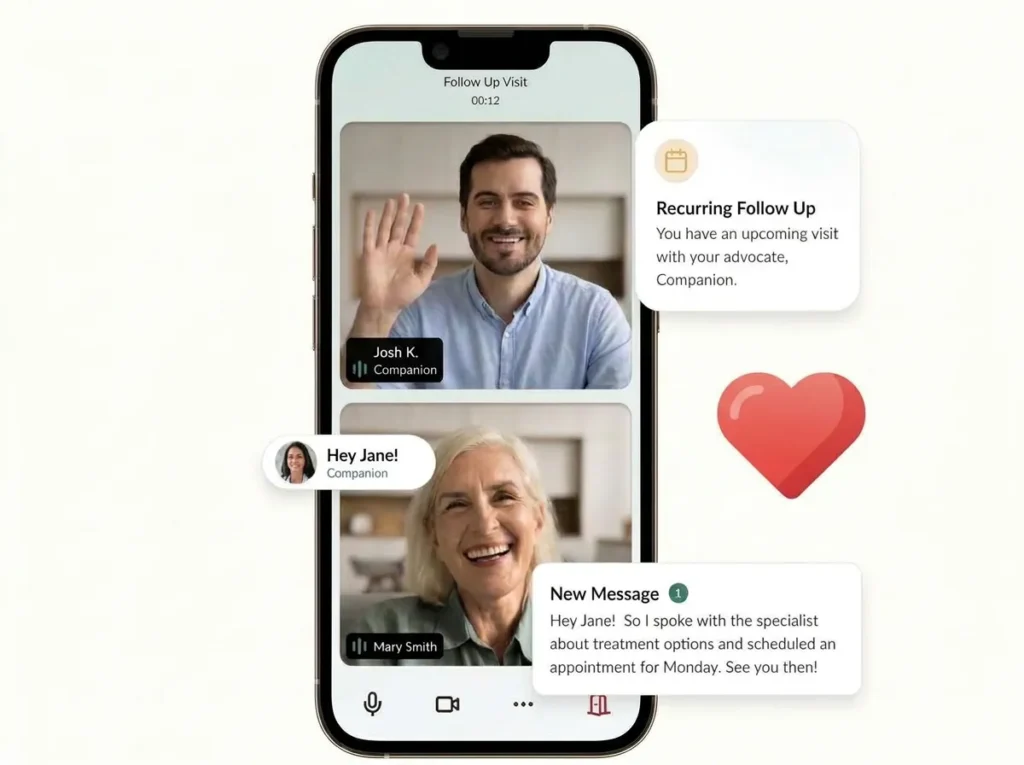
Companian follows your HIV and hepatitis patients and helps with the housing, food and rides they need.
- No new hires. We run outreach, consent and monthly calls.
- One file a month. Nothing is billed until you approve it.
- $0 upfront. Works with your EHR, live in about a week.
$66.13* per patient, every month*Infectious disease CCM, CPT 99490 (2026 national rate)
Get your CCM Plan
Works nationwide
Practices nationwide
You bill under your own NPI
Same Care Advocate every month
RNs, NPs, LCSWs and care companions
Monthly file approved by your team
No new hires needed


One Care AdvocateSame person, every month
Your NPI, your claimYou bill Medicare directly
Monthly billing fileYour team approves it
What the care plan covers between visits
Four areas, and where each answer goes.
HIV
Your plan’s antiretroviral adherence questions are asked monthly. Missed doses or pharmacy problems go to your office; viral load and CD4 draws are confirmed.
Chronic hepatitis B
Monitoring labs and liver imaging are confirmed on your clinicians’ interval. Antiviral therapy questions go straight to your team.
Chronic hepatitis C
Before treatment, start-up labs and visits are confirmed. During treatment, adherence questions are asked monthly; the post-treatment lab draw is confirmed when due.
Housing, food and transport
When rent, food or a ride stands between the patient and treatment, the Care Advocate records it and connects them to your plan’s resources.

What 80 HIV and chronic hepatitis patients bring in each month
2026 Medicare-allowed amounts, and the diagnosis codes that qualify.

Example panel
$5,290 / month
$63,485 a year · 80 patients × $66.13 (CPT 99490, national)
- CPT 99490 pays $66.13 per patient-month nationally (2026).
- Your locality moves it up or down: $60.71 in Arkansas to $83.76 in Alaska.
- Each extra 20 minutes adds CPT 99439 at $50.44.
| Condition | ICD-10 examples | Program fit |
|---|---|---|
| HIV disease | B20 | CCM with a second condition; PCM alone |
| Asymptomatic HIV status | Z21 | CCM with a second condition |
| Chronic hepatitis B | B18.1 | CCM with a second condition |
| Chronic hepatitis C | B18.2 | CCM with a second condition |
PCM, CCM, CHI or PIN for infectious disease patients
The code depends on how much care you manage and what blocks treatment.

| Code family | When it applies | Monthly time rule | 2026 national payment |
|---|---|---|---|
| PCM · 99426, 99427 | HIV, chronic hepatitis B or chronic hepatitis C is the one serious, high-risk condition your practice manages, expected to last at least 3 months | 30 minutes or more of clinical staff time; each further 30 is 99427 | $67.80 national |
| CCM · 99490, 99439 | Your practice also manages hypertension, diabetes or another long-term condition: two or more chronic conditions lasting at least 12 months with significant risk | 99490 from 20 minutes; each further 20 is 99439 | $66.13 and $50.44 national |
| CHI · G0019, G0022 | An unmet upstream driver, one of the social determinants of health, interferes with diagnosis or treatment | G0019 for the first 60 minutes; each further 30 is G0022 | $86.17 and $54.11 national |
| PIN · G0023, G0024 | One serious, high-risk condition with risk of hospitalization, acute decompensation or functional decline that needs navigation | G0023 for the first 60 minutes; each further 30 is G0024 | $87.18 and $54.44 national |
Hepatitis C treatment months
Hepatitis C pre-treatment and treatment months center on one condition, so check PCM first. Your practitioner decides if the serious, high-risk test is met. See PCM CPT codes.
Starting CHI
CHI begins after an initiating visit your practitioner performs personally: an E/M visit other than 99211, and from 2026 also a psychiatric diagnostic evaluation (90791). Consent is documented once. See CHI codes G0019 and G0022.
If you provide all primary care
A practice responsible for all of a patient’s primary care can bill advanced primary care management (G0556 to G0558) instead of CCM. It has no time threshold. Companian sets APCM up practice by practice.
How an infectious disease month runs
Privacy first, then the plan’s questions, then minutes sorted by program.
You pick patients
Patients come by referral form or EHR access, each with the program your practitioner picked.
Consent on a private call
After your approval, the Care Advocate explains the program and records verbal consent. Calls stay private under HIPAA.
The adherence call
The plan’s adherence questions, the next lab draw and the next visit, each confirmed with the patient and recorded.
Minutes by program
CHI time on social needs and PCM or CCM time are logged separately in the file your team approves.

What stays with your clinicians
Care Advocates ask, record, confirm and route. Medicine is yours.
| Task | Your infectious disease team | Companian Care Advocate |
|---|---|---|
| Antiretroviral or antiviral regimen | Chooses it, changes it and counsels the patient | Asks the plan’s adherence questions and passes on missed doses |
| Viral load, CD4 and liver tests | Orders and interprets every result | Reminds the patient and confirms the draw happened |
| Social needs | Holds the initiating visit and decides whether CHI applies | Records the barrier and connects the patient with listed resources |
| Care plan | Writes and updates it | Works from it on every call |
| Medicare claim | Bills under its own NPI through its Medicare contractor | Prepares the monthly file and does not bill Medicare |
Registered nurses, licensed clinical social workers, nurse practitioners and care companions call by phone or video, under your billing practitioner’s general supervision. Confirm the services agreement with your counsel. Gloria, our AI assistant, drafts documentation and pre-visit summaries; people make every call.

Chronic care management for infectious disease practices: FAQ

Do CHI and PIN consent work the same way?
No. CHI consent is documented once, before services start. PIN consent is obtained before or when services begin and renewed annually. Companian documents verbal consent, and the monthly file shows the date.
Can CHI be billed on top of PCM or CCM?
Yes. CMS allows CHI and PIN in addition to other care management when time and effort are not counted more than once.
Can another practice bill CCM for the same patient?
Only one practitioner can bill CCM per patient per calendar month. If the primary care practice already bills it, discuss PCM for HIV or hepatitis instead. Our explainer, what is chronic care management, covers the other program rules.
What does the patient pay?
The Medicare Part B deductible and coinsurance apply to PCM, CCM, CHI and PIN alike. The Care Advocate explains this before the patient consents.
Rates & disclosures
National amounts are 2026 Medicare Physician Fee Schedule non-facility payments at the non-QP conversion factor of $33.4009, computed from CMS RVUs. Your amount depends on your Medicare payment locality; see it in the CCM/PCM revenue calculator. Actual payment depends on participation status, place of service and cost-sharing.
Companian supplies Care Advocates and documentation to physician practices nationwide. Companian is not a medical practice and does not bill Medicare. The billing practitioner keeps the care plan, every clinical decision and the claim. Patients pay the usual Medicare Part B deductible and coinsurance for these services unless other coverage pays it.
Care management for other specialties
The same Care Advocates and monthly file, written to each specialty’s conditions.
Add infectious disease care management
A 15-minute call on which codes fit your patients. No patient data needed.