
Home / Billing guides / APCM behavioral health add-ons
APCM behavioral health add-on codes G0568, G0569 and G0570
Three 2026 add-ons that pay for collaborative care and general BHI inside an APCM month.
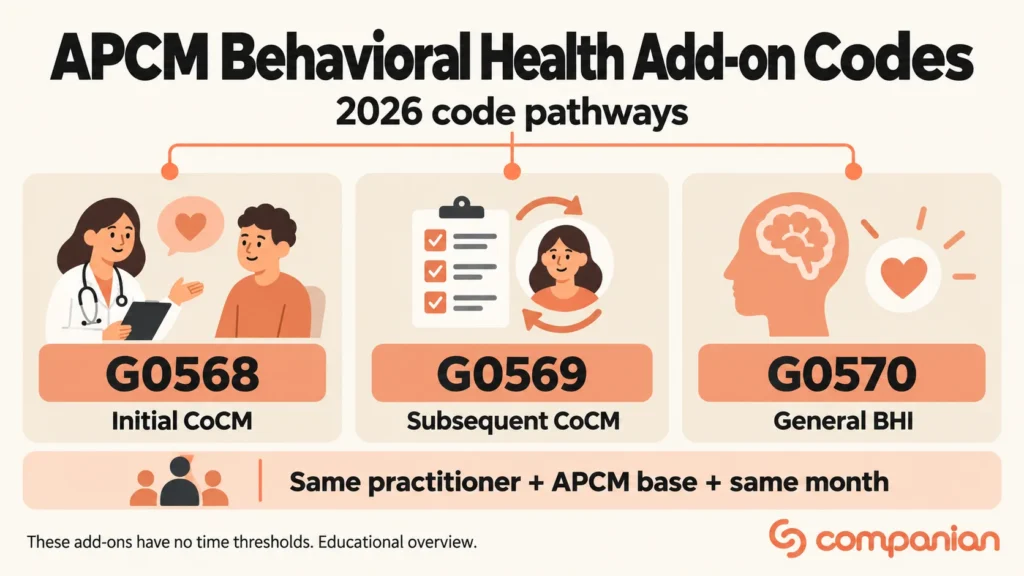
Short answer: APCM behavioral health add-on codes are G0568 for initial psychiatric collaborative care, G0569 for subsequent collaborative care and G0570 for general behavioral health integration. Starting in 2026, the same practitioner reports the add-on and an APCM base code in the same month; these add-ons do not have time thresholds.
APCM behavioral health add-on codes let the same practitioner report qualifying behavioral health integration or psychiatric collaborative care alongside advanced primary care management in the same calendar month. They are optional, non-time-based add-ons, not stand-alone services or automatic additions for every APCM patient.
The billing decision has two parts: whether the APCM base service is valid and whether the practice furnished the behavioral service represented by the add-on. Removing a minute threshold does not remove the service requirements.
Match the service, practitioner and month
Clinical model: Distinguish initial CoCM, subsequent CoCM and general BHI.
Base service: The same practitioner must report an APCM base in the same month.
Documentation: Show the required care and team roles even though the add-on is not time-based.

The three APCM behavioral health add-on codes
CMS created these codes for CY2026 to accompany advanced primary care management, or APCM. Psychiatric collaborative care model is abbreviated CoCM; general behavioral health integration is abbreviated BHI.
| Add-on | Service | Comparable standalone CPT code | Month distinction |
|---|---|---|---|
| G0568 | Psychiatric CoCM | 99492 | Initial month |
| G0569 | Psychiatric CoCM | 99493 | Subsequent month |
| G0570 | General BHI | 99484 | General BHI service for the month |
Comparable does not mean interchangeable. The CPT codes describe the standalone pathways; the G-codes in this table are the APCM add-ons with their own base-service attachment requirement.
The APCM base-code guide explains the underlying monthly service. The mental health CPT code guide provides broader code context when the practice is working outside this specific APCM arrangement.
APCM behavioral health add-on codes require the same practitioner
The practitioner reporting the APCM base must also report the behavioral add-on in that calendar month. A shared group name or a common billing office does not replace the same-practitioner requirement.
For a simple example, practitioner A reports the APCM base while practitioner B reports a proposed add-on. That proposal does not satisfy the attachment rule, even if both practitioners work in the same practice.
The month must match as well. An APCM base in one calendar month does not support an add-on describing behavioral care in a different month.
A qualifying base is necessary, but not sufficient
Base present: Confirm the APCM base service for the patient and calendar month.
Practitioner matched: Confirm the same billing practitioner for base and add-on.
Behavioral care furnished: Confirm the general BHI or CoCM service represented by the selected code.
These are checks of service validity, not a promise that a claim will pay. Resolve uncertain claim-processing scenarios with the practice’s MAC instead of using a matching code pair as the only review.
What changes when monthly minute thresholds are removed
APCM does not require clinical-staff minute thresholds. The new behavioral add-ons are also not time-based when furnished with APCM; do not copy the standalone CPT minute thresholds onto these G-codes.
CMS nevertheless states that the practice must meet all requirements and bill an APCM base code in the same month. The record still needs to explain what care was furnished, which model was used and how the treating practitioner remained involved.
The practical shift is from asking only whether enough minutes accumulated to asking whether the required monthly service occurred. A short generic outreach note does not explain a collaborative care service simply because the code is not time-based.
For an internal review, separate the code’s threshold rules from the practice’s operational time records. Removing a billing threshold does not require a practice to discard records it uses for staffing, supervision or coordination.
General BHI and CoCM require different care arrangements
General BHI uses an ongoing behavioral care model
CMS describes general BHI as systematic assessment and monitoring, care-plan adjustment when needed and a continuous relationship with an appointed team member. A psychiatric consultant or behavioral health care manager may participate, but is not required for the general BHI model.
Before BHI begins, CMS requires the patient’s permission for the billing practitioner to consult relevant specialists and an explanation that cost sharing applies. Verbal consent is permitted and must be documented; a new consent is required if the patient changes billing practitioners.
A practice considering the general BHI add-on should assess whether its existing work is a continuing integrated service. An isolated administrative contact should not be assumed to establish the care model.
CoCM includes a specific team
CMS identifies a treating billing practitioner, behavioral health care manager and psychiatric consultant for CoCM. That team requirement is separate from whether a monthly minute threshold applies.
Before adopting a CoCM add-on, the practice should identify the actual people filling those roles. A generic care-coordination service does not establish the psychiatric consultant role or the collaborative model.
Initial and subsequent CoCM months are different
Use the initial or subsequent distinction from the service being furnished. A practice should have a way to identify that status in its record, so a recurring monthly template does not obscure which CoCM code it is proposing.
Do not choose between these models by the payment amount or by which code is easier to enter. Begin with the clinical service, then verify the matching APCM attachment and billing requirements.

A monthly review process for the billing team
1. Confirm the APCM base pathway
The base codes distinguish APCM patient groups: G0556 concerns one chronic condition or fewer, G0557 concerns two or more, and G0558 concerns a Qualified Medicare Beneficiary with two or more. The underlying practitioner is responsible for the patient’s primary care.
2. Identify the behavioral service and its team
Ask the clinical team whether the month represents general BHI, initial CoCM or subsequent CoCM. Confirm the service details before a billing template assigns the corresponding add-on.
3. Reconcile the practitioner and calendar month
- Find the APCM base service for the patient and month.
- Match the billing practitioner to the proposed behavioral add-on.
- Check the clinical record for the behavioral model and month distinction.
- Return missing or inconsistent information to the treating practitioner before submission.
These are practical checks for a practice workflow, not a CMS-prescribed document layout. Keep them near the monthly billing review so the team can distinguish a missing record from a clinical requirement that was not met.
4. Review changes rather than copying last month
The APCM relationship may continue while behavioral care changes. The add-on is optional and should follow the service furnished in that month, rather than automatically recurring because it appeared on the previous claim.
How the add-ons sit beside other care-management codes
The same practitioner cannot report APCM with CCM, PCM or transitional care management for that patient in the same month. A different practitioner may furnish a medically necessary separately billable service; the behavioral add-on attachment still requires the APCM practitioner.
CMS permits community health integration and principal illness navigation alongside APCM. That concurrent-billing permission does not turn those services into substitutes for BHI or CoCM, or remove their own qualifying-service requirements.
For a practice reviewing a patient’s whole claim record, check who furnished each service and which rules govern that combination. The exception allowing a different practitioner to bill some services does not allow that practitioner to attach these behavioral add-ons to someone else’s APCM base.
Companian does not offer behavioral health integration or psychiatric collaborative care. The code explanation here is educational, so a practice needs its own appropriate behavioral care arrangement before considering these add-ons.

Separate primary care support from the behavioral service
A practice assessing advanced primary care management should decide how its primary care workflow and any separately arranged behavioral care fit together. Confirm the clinical model and responsible practitioner before choosing an add-on.
Companian: “Your team refers; we handle enrollment, outreach and documentation. You bill monthly under your license.”
Key takeaways
- The three behavioral add-ons are optional services paired with an APCM base.
- The same practitioner must report the base and add-on in the same calendar month.
- G0568 and G0569 distinguish initial and subsequent CoCM.
- G0570 describes general BHI alongside APCM.
- Removing time thresholds does not remove service requirements.
Frequently asked questions about apcm behavioral health add-on codes
Can another practitioner in our group attach G0568 to the APCM claim?
The same practitioner must report the APCM base and behavioral add-on in the same month. Group membership alone does not meet that condition.
Do the APCM behavioral add-ons use standalone BHI minute thresholds?
No, these add-ons are not time-based when furnished with APCM. The underlying service requirements still apply.
Does every APCM patient automatically receive a behavioral add-on?
No, the add-ons are optional and require the corresponding behavioral service. A valid APCM base by itself is insufficient.
Which APCM add-on distinguishes continuing collaborative care?
G0569 describes the subsequent CoCM month. G0568 concerns the initial CoCM month.
Is the psychiatric consultant role required for general BHI?
CMS permits general BHI models without a psychiatric consultant. CoCM has a different team structure that includes that role.
Can an APCM base in a later month support earlier behavioral work?
The base and behavioral add-on must be reported by the same practitioner in the same month. A base service in another month does not satisfy that attachment rule.
Medicare Part B APCM behavioral add-on codes G0568, G0569 and G0570 concern qualifying CoCM or general BHI alongside monthly APCM in physician practices; Companian does not offer BHI or CoCM. Companian: “Your team refers; we handle enrollment, outreach and documentation. You bill monthly under your license.”
Read more: APCM base-code levels · Behavioral code context
Plan APCM around your patient panel
See how Companian runs advanced primary care management for practices nationwide. Your practice bills Medicare under its own NPI.
Sources
- CY 2026 PFS final rule, 90 FR 49266 (APCM add-ons at 49469 to 49471)
- CMS MLN MM14315, CY 2026 PFS final rule summary
- CMS, Advanced Primary Care Management services
- CMS MLN006397, FQHC booklet
- CMS 2026 Physician Fee Schedule relative value files (RVU26D)
Rates & disclosures
National amounts are 2026 Medicare Physician Fee Schedule non-facility payments at the non-QP conversion factor of $33.4009, computed from CMS RVUs. Your amount depends on your Medicare payment locality; see it in the CCM/PCM revenue calculator. Actual payment depends on participation status, place of service and cost-sharing. Companian supplies Care Advocates and documentation to physician practices nationwide. Companian is not a medical practice and does not bill Medicare. The billing practitioner keeps the care plan, every clinical decision and the claim. Patients pay the usual Medicare Part B deductible and coinsurance for these services unless other coverage pays it.