
Home / Billing guides / CCM in-house vs staffed
Chronic care management in house or with a staffed partner: a decision guide
A decision guide for practices weighing an in-house CCM team against a staffed partner.
Short answer: Chronic care management in-house vs outsourced changes who supplies staff and organizes daily work, while the billing practitioner retains clinical involvement, supervision and billing responsibility. Compare staff availability, record access, patient contact, escalation and claim review before choosing either model.

Chronic care management in-house vs outsourced is a staffing and workflow decision under the same Medicare requirements. An internal team performs the operational work in-house; an external team performs agreed tasks in an outsourced arrangement, with the billing practitioner retaining required involvement.
Choose the model your practice can direct and document consistently. Neither removes eligibility, consent, care planning or the need to review the service before billing.
TL;DR: assign the work without losing the practitioner connection.
In-house: Your practice supplies and manages the operational team, coverage process and documentation workflow.
Outsourced: An external team performs agreed work; CMS permits contracted clinical staff when incident-to and other CCM requirements are met.
Both: The billing practitioner retains required involvement and the practice confirms the services supporting its claim.
Chronic care management in-house vs outsourced: the rules stay
CMS permits clinical staff to be employees or people working under contract with the billing practitioner. External staffing is allowed when incident-to and other CCM billing rules are met. The employment arrangement alone does not establish that a service qualifies.
CMS cautions that little practitioner oversight or a lack of clinical integration with a third party can mean CCM was not actually furnished. The billing practitioner cannot fully delegate required involvement. A contract needs an operational connection to the practice, not only a monthly spreadsheet.
| Rule | In-house CCM | Outsourced CCM |
|---|---|---|
| Eligibility | Practice confirms multiple qualifying chronic conditions | Practice confirms the same eligibility before referral |
| Clinical-staff arrangement | Employees may furnish eligible work under direction | Contracted personnel may furnish eligible work when rules are met |
| General supervision | Billing practitioner retains direction and control | Billing practitioner retains the same direction and control |
| Consent | Documented written or verbal consent before billing | Same requirement; agreement identifies the consent workflow |
| Comprehensive care plan | Electronic plan established, revised or monitored | Same plan requirement, with practical team access |
| Monthly time | 99490 requires at least 20 qualifying minutes | Same threshold; external staffing does not change it |
| Practitioner involvement | Required involvement remains with the practitioner | Cannot fully delegate required involvement |
Use the comparison as a responsibility test. If an external arrangement cannot show how the practitioner directs care and receives updates, it is not ready just because someone can make calls. An internal arrangement needs the same clarity when work is spread across employees.
Eligibility, consent and care planning before staffing
Eligibility belongs to the clinical assessment
CCM requires two or more chronic conditions expected to last at least 12 months or until death, with significant risk of death, acute exacerbation or decompensation, or functional decline. Have the billing practitioner confirm the qualifying needs and plan scope. A patient list prepared for outreach should not silently become an enrollment decision.
Consent needs a named workflow owner
The practice obtains written or verbal CCM consent and documents the required explanation before billing. The patient hears that CCM is available, cost sharing may apply, one practitioner can provide and bill CCM in a calendar month, and the patient may stop effective at month end. Record acceptance or refusal rather than treating an unanswered call as agreement.
Consent is obtained once unless the patient changes billing practitioners. A partner change prompts a review of who will bill and what the existing record supports; it does not create a universal annual signature rule. Agree on who checks the record, handles questions and updates the patient decision.
Connect daily work to the care plan
CMS calls for an electronic comprehensive care plan based on assessment of the patient and available resources and supports. Suggested office practice is to give the operational team access to the current plan and a route for returning changes for clinical review. Neither an internal worksheet nor an external call log substitutes for the plan.
For new patients or patients not seen by the billing practitioner within the previous year, CCM requires an initiating visit before services begin. The billing practitioner furnishes a qualifying comprehensive face-to-face E/M visit, annual wellness visit or IPPE and discusses CCM. Keep that evidence with the practice regardless of staffing model.
In-house vs outsourced chronic care management: records
Compare the same code pathway
In the clinical-staff pathway, 99490 requires at least 20 minutes of qualifying time per calendar month. Code 99439 describes each additional 20 minutes. Compare the same code family in each model so differences in the service are not mistaken for staffing effects.
CMS allows time spent directly by the billing practitioner or qualifying clinical staff for these codes under applicable rules. Not every administrative task or every person making a call qualifies. Identify the personnel, service and care-plan purpose before totaling minutes.
Ask for records a second person can understand
- Identify the patient, calendar month and responsible billing practitioner.
- Identify the person performing each activity and the documented time.
- Connect activities to the current care plan and show clinical handoffs.
- Keep consent and required initiating-visit evidence retrievable.
Those are practical review fields, not a promise that one file format satisfies every audit. Ask an internal coordinator or external company to walk through a sample record from activity to proposed claim. A total that cannot be traced back to work needs explanation before approval.
Use the chronic care management workflow guide for the sequence from outreach to monthly review. Establish who performs each handoff and what evidence moves with it. Keep operational instructions separate from the billing team’s final code determination.

Oversight and concurrent billing do not transfer away
Supervision: Clinical-staff CCM is under general supervision; the billing practitioner keeps direction and control without requiring physical presence.
Clinical involvement: CMS does not permit the billing practitioner to delegate all required involvement to an external company.
Other services: The practice still checks incompatible combinations and prevents time from supporting another billed service.
For CCM and principal care management, the same practitioner cannot bill both for the same patient and month. Different practitioners may furnish them for different conditions with two care plans. A new internal department or partner does not reset that rule.
The practitioner billing advanced primary care management cannot report CCM or PCM for that patient in the same month. A different practitioner may report medically necessary listed services under the applicable rule. Give the reviewer the actual practitioner and month rather than asking a staffing company for a blanket determination.
As an office procedure, name who receives clinical questions during the workday and who covers that function when the usual person is absent. Distinguish routine outreach from CMS access requirements. Test whether a change reaches the responsible professional before relying on a proposed workflow.
Which model can your practice actually operate?
When in-house may fit
Consider an internal team when the practice can assign personnel, cover absences, supervise activity and keep records usable for billing. Walk through the real schedule with the people who would do the work. Avoid treating unassigned time between other duties as an established service process.
When an external team may fit
Consider an external arrangement when the practice wants help with agreed tasks and can maintain the necessary clinical connection. Ask for handoffs, sample documentation and the method for escalating questions. Translate partner assurances into a written division of work your staff can explain.
- Map current tasks, staff coverage and unresolved work.
- Use the same sample patient and month to compare both models.
- Assign consent, plan updates, clinical questions and billing review to named roles.
- Ask how records remain available during a change or termination.
- Resolve unanswered responsibilities before starting the arrangement.
Review contract scope, staffing responsibilities, records access and exit arrangements with your team. This article does not assume a provider has agreed to a transfer timetable or continued access after termination. Put the terms in writing and verify the handover process.
The guide to choosing a chronic care management company turns those handoffs into partner questions. Use it after deciding what your practice needs help doing. End the comparison with an operating plan rather than a generic claim that one model always costs less.
A mixed arrangement also needs clear ownership. If your existing coordinator continues working with some patients while another team takes others, identify which records and follow-up duties belong to each team. Do not assume that sharing the workload means another person has checked consent or approved the claim.
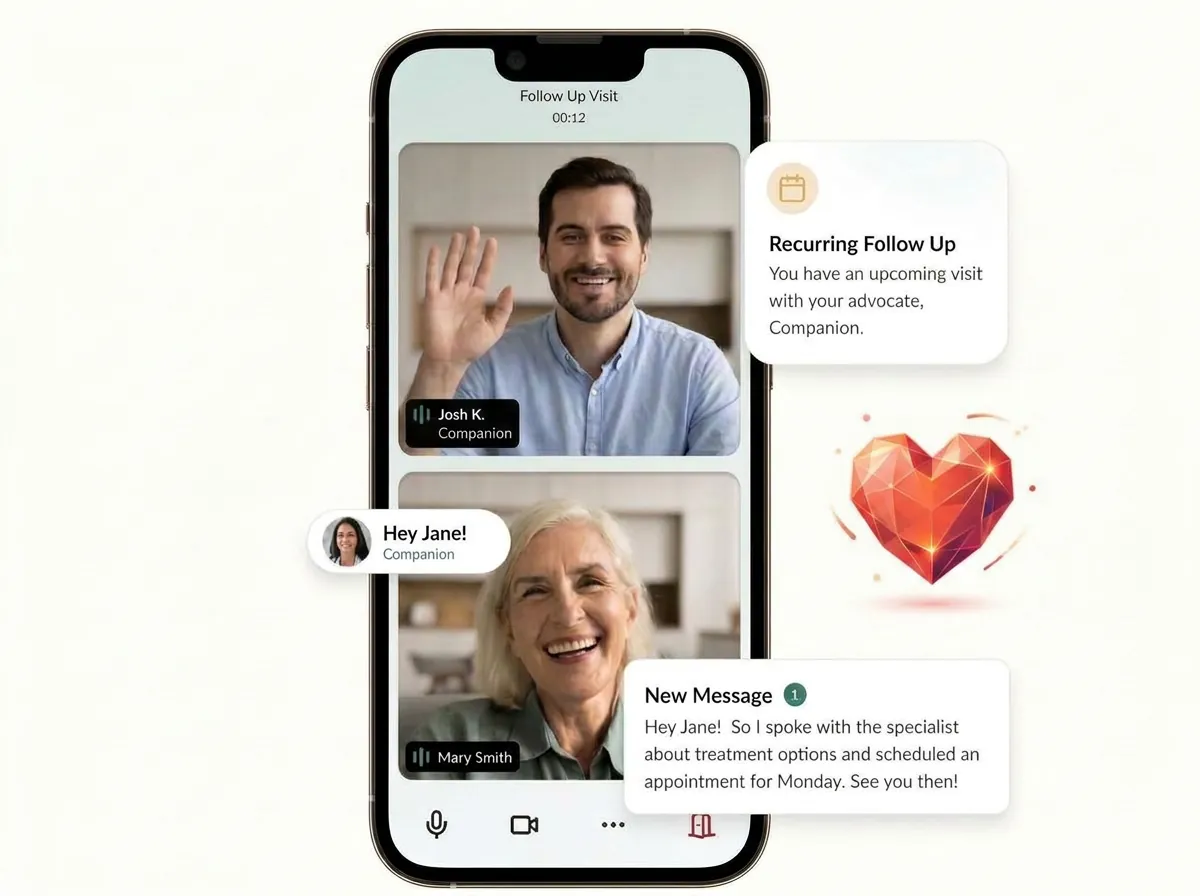
Discuss responsibilities before referring patients
Review outsourced chronic care management for practices if an external team fits your operating plan. Bring the responsibilities you want to assign and the records your billing team needs.
Your team refers; we handle enrollment, outreach and documentation. You bill monthly under your license. Which team members’ time counts toward each code is set in your services agreement.
Companian offers one dedicated Care Advocate, the same person every time. Confirm the workflow and agreement terms rather than assuming a staffing contract replaces practice decisions.
Key takeaways
- Both staffing models must satisfy the same CCM eligibility and service rules.
- CMS permits external clinical staff when incident-to and other requirements are met.
- The billing practitioner retains required involvement and general supervision.
- Consent, care planning and qualifying-time records need clear owners.
- Compare handoffs, coverage and record access before choosing.
Frequently asked questions about chronic care management in house vs outsourced
Does outsourcing CCM transfer the practitioner’s clinical responsibility?
No, CMS requires the billing practitioner to retain involvement. External staffing arrangements must maintain oversight and clinical integration with the practice.
Can a practice use contracted staff instead of employees for CCM?
CMS permits contracted clinical staff when incident-to and other CCM requirements are met. Applicable state law, licensure and scope-of-practice conditions still apply.
What should an in-house CCM coordinator show billing?
The team should trace the monthly record to personnel, activities, qualifying time and care-plan work. The practice also needs consent and required initiating-visit evidence behind the service.
Should a CCM comparison assume lower costs from either model?
No, review the actual work and agreement terms before making a financial decision. This comparison makes no savings or payment promise for either model.
Can two staffing teams create two CCM claims for one patient?
No, patients must be told that only one practitioner can provide and bill CCM during a calendar month. Splitting personnel across teams does not create another monthly benefit.
What should the practice verify before changing CCM companies?
Review the billing practitioner, existing consent, current plan and access to records. Confirm transfer and exit terms in writing rather than assuming a standard arrangement.
Physician practices can organize Medicare Part B chronic care management, including 99490 and 99439, through internal or permitted contracted staffing. For Companian, your team refers; we handle enrollment, outreach and documentation. You bill monthly under your license.
Read more: Choosing a CCM company · CCM workflow · General supervision
Compare a staffed partner with your own team
See how Companian runs outsourced chronic care management for practices nationwide. Your practice bills Medicare under its own NPI.
Sources
- CMS MLN909188, Chronic Care Management Services
- CMS, Chronic Care Management FAQs
- 42 CFR 410.26, incident-to services
- CMS fact sheet, CY 2027 Physician Fee Schedule proposed rule
Disclosures
Companian supplies Care Advocates and documentation to physician practices nationwide. Companian is not a medical practice and does not bill Medicare. The billing practitioner keeps the care plan, every clinical decision and the claim. Patients pay the usual Medicare Part B deductible and coinsurance for these services unless other coverage pays it.
This guide summarizes CMS rules for practices nationwide and is not legal or billing advice.