
Home / APCM vs CCM
APCM vs CCM: which program to bill for which patient
APCM vs CCM: are you the primary care home, and how many months reach 20 minutes?
Short answer: APCM vs CCM compares a monthly advanced-primary-care bundle without minute thresholds with time-based chronic care management for multiple qualifying conditions. APCM requires responsibility for all primary care; the same practitioner cannot bill APCM and CCM for the same patient in the same month.

APCM vs CCM is a choice between a monthly primary-care bundle and a time-based chronic-condition service. Advanced primary care management (APCM) covers patients across complexity levels; chronic care management (CCM) requires two or more qualifying chronic conditions and a comprehensive care plan.
Choose around the practitioner’s responsibility, the practice’s capabilities and the services the patient needs. Removing a minute threshold does not remove consent, care planning or billing requirements.
TL;DR: compare responsibility and requirements before changing code families.
APCM: G0556, G0557 and G0558 are monthly bundle codes without clinical-staff minute thresholds.
CCM: 99490 starts at 20 minutes of qualifying clinical-staff time per calendar month; 99439 covers additional 20-minute increments.
Concurrent billing: The same practitioner cannot report both for one patient and month; a different practitioner may report medically necessary services under the applicable rules.
APCM vs CCM eligibility: who and what qualify?
APCM is directed by a physician or other qualified health professional responsible for all of the patient’s primary care and serving as the continuing focal point for needed health services. Its three levels distinguish patients with one chronic condition or fewer, those with multiple qualifying chronic conditions, and Qualified Medicare Beneficiaries with multiple qualifying conditions. That primary-care responsibility matters as much as the condition count.
CCM addresses two or more chronic conditions expected to last at least 12 months or until death, placing the patient at significant risk of death, acute exacerbation or decompensation, or functional decline. The practice establishes, implements, revises or monitors a comprehensive care plan. Count the qualifying conditions and assess their risk rather than selecting CCM from an unreviewed diagnosis list.
| Rule | APCM | CCM |
|---|---|---|
| Practitioner responsibility | All primary care and continuing focal point for needed services | Direction of qualifying chronic care management |
| Condition threshold | Three complexity levels; includes one condition or fewer | At least two qualifying chronic conditions |
| Clinical-staff timing | No minute threshold | 99490: at least 20 minutes per calendar month |
| Code structure | G0556, G0557 or G0558 | 99490 plus 99439 for additional time in this pathway |
| Consent | Before starting; written or verbal, documented | Written or verbal, documented before billing |
| Same practitioner and month | Cannot combine with CCM or PCM for the patient | Cannot combine with APCM for the patient |
The comparison is not a test of whether a practice wants less timekeeping. A practice must be able to furnish and document the selected service. Review APCM codes G0556, G0557 and G0558 for level-specific coding details before setting up claims.
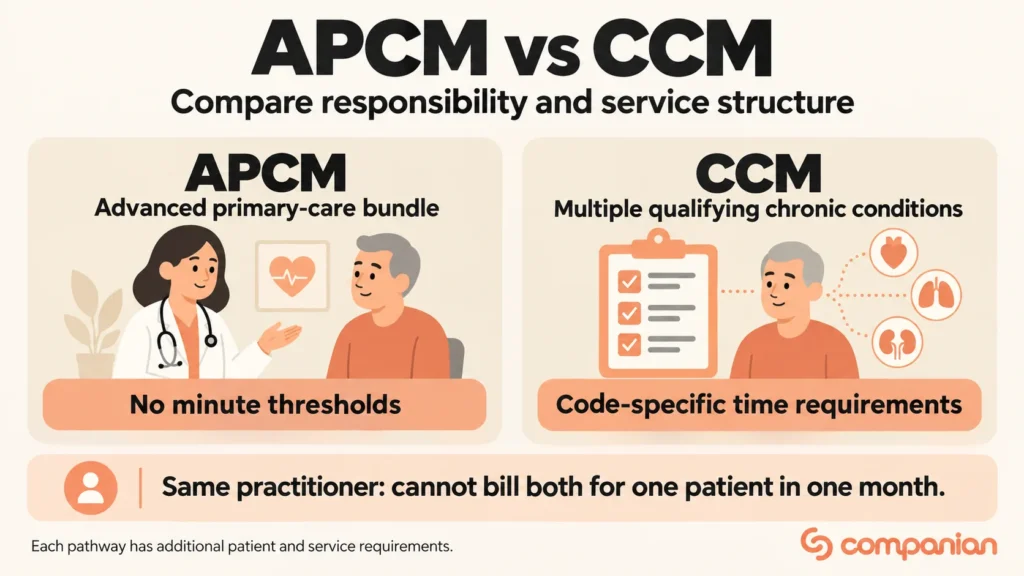
APCM vs CCM codes, time and documentation
APCM: no minute floor, but a documented service
G0556 is the APCM level for a patient with one chronic condition or fewer. G0557 applies to two or more qualifying chronic conditions; G0558 adds Qualified Medicare Beneficiary (QMB) status to that multiple-condition category. These are monthly codes, not add-ons to one another.
CMS says APCM services are not time based and can be billed once per patient per calendar month when requirements are met. Do not turn that into a claim for every name on the patient list. The record needs to support the appropriate level and clinically appropriate service elements.
CCM: keep a traceable qualifying-time record
For the clinical-staff CCM pathway, 99490 requires at least 20 minutes per calendar month. Add-on 99439 describes each additional 20 minutes. The time and the comprehensive service requirements both matter; a total alone is not the whole record.
Other CCM pathways cover personally furnished practitioner work or complex CCM, with their own descriptors and restrictions. This comparison uses 99490 and 99439 to keep the primary-care decision clear. Refer a different pathway to the relevant code guide instead of applying these thresholds across the entire CCM family.
As an office procedure, keep the patient, practitioner, calendar month, care-plan work and billing decision connected in both programs. For CCM, retain the qualifying-time details as well. For APCM, organize evidence by the service requirements rather than manufacturing a minute threshold that CMS does not require.

Consent and the initiating visit are separate checks
APCM consent and its initial-visit exceptions
For APCM, obtain written or verbal consent before services start and document it in the medical record. Explain that only one provider can furnish and be paid for APCM during a calendar month, the patient may stop at any time, and cost sharing may apply. CMS says consent needs to be obtained once.
CMS calls for a separately paid initiating visit for new APCM patients, with exceptions if you or another provider in the practice has seen the patient within the past 3 years or provided APCM, CCM or PCM within the past year. Keep evidence supporting an exception instead of substituting the CCM look-back rule. A familiar patient name in the scheduling system is not enough to establish which exception applies.
CCM consent and its own initiating-visit rule
For CCM, the practice documents written or verbal consent and the explanation of availability, possible cost sharing, one practitioner per calendar month and the right to stop effective at month end. Consent is obtained once unless the patient changes billing practitioners. The initiating visit and consent remain separate requirements.
CMS requires a CCM initiating visit for new patients or patients the billing practitioner has not seen within the previous year. A comprehensive face-to-face E/M visit, annual wellness visit or IPPE can qualify, and the billing practitioner must discuss CCM. Do not assume that a qualifying APCM visit exception also proves the CCM visit requirement.
Concurrent billing: the same-practitioner boundary
A monthly bundle changes what the same practitioner may report separately.
APCM with CCM or PCM: Not reportable by the same practitioner for the same patient in the same month.
Another practitioner: CMS permits a different practitioner to report the listed services when medically necessary, including within the same practice.
Other programs: CMS permits certain services alongside APCM, but each service keeps its own requirements and current coding rules.
The final APCM rule’s restriction applies to the same practitioner; do not broaden it into a categorical ban on every practitioner in the same organization. Its listed services include CCM, PCM, transitional care management, interprofessional consultation, remote evaluation, virtual check-ins and e-visits. Identify the actual furnishing and billing practitioner before deciding that two claims conflict.
CMS allows concurrent billing of APCM with behavioral health integration, community health integration, principal illness navigation and remote monitoring services under the applicable rules. Behavioral health services alongside APCM have specific add-on codes introduced for 2026. These combinations are billing context here, not permission to report overlapping work twice.
A patient needing disease-specific management from a specialist may raise a different question from a patient receiving all primary care from one practitioner. The PCM vs CCM comparison explains the disease-specific versus comprehensive distinction. Review the patient’s current program and responsible practitioners before changing the monthly claim.
As a billing-team procedure, check both your own claims and known care-management arrangements with other practitioners. Record the service month, practitioner and program so a second reviewer can see the decision. Escalate uncertainty to the current CMS or Medicare contractor guidance rather than relying on a blanket software exclusion.
Which practice capabilities determine the fit?
APCM requires more than replacing a time log
CMS lists access and continuity, comprehensive care management, an electronic patient-centered care plan, transitions, coordination and enhanced communication among APCM requirements. It also includes population-level management and performance measurement. The clinically appropriate elements need to be furnished, although CMS does not require every listed service every month.
- Map urgent access and continuity arrangements to the practice’s actual coverage process.
- Check whether the care team can access and update the electronic comprehensive plan and share it appropriately.
- Confirm the population-management and performance-reporting process the practice will use.
Those are capability-review prompts, not a claim that selecting an APCM code creates the underlying system. Ask the clinical lead, administrator and billing lead to walk through a sample patient together. The gaps should become named tasks with owners before the first claim is approved.
CCM keeps a defined chronic-condition service pathway
A practice evaluating CCM should check the qualifying conditions, comprehensive plan, access and continuity, consent and monthly qualifying work. Clinical-staff CCM operates under the billing practitioner’s general supervision. That means overall direction and control, without requiring the practitioner’s physical presence during the service.
- Identify the practitioner’s actual primary-care responsibility and the patient’s qualifying needs.
- Compare required service capabilities and record any missing process.
- Check the consent record, initiating visit or applicable exception, and proposed code level.
- Review competing monthly services and the responsible practitioners.
- Approve the claim only after the practice confirms the documented work supports its chosen pathway.
The selection can differ across patients and can change when responsibility or needs change. Keep the reason in the record and communicate the decision to the billing team. Neither program is a universal winner, and neither choice supports an outcome or payment promise.

Discuss the workflow your practice can sustain
Companian supports advanced primary care management (APCM) for partner practices; the practice bills G0556, G0557 and G0558 under its own NPI. Review advanced primary care management for practices to discuss the operational handoffs.
Your team refers; we handle enrollment, outreach and documentation. You bill monthly under your license. Which team members’ time counts toward each code is set in your services agreement.
Bring questions about patient selection, records and responsibilities to the discussion. Keep the final clinical and billing decisions with the practice.
Key takeaways
- APCM is a monthly advanced-primary-care bundle without minute thresholds.
- CCM requires multiple qualifying chronic conditions and the selected pathway’s time threshold.
- APCM consent and initial-visit exceptions differ from CCM requirements.
- The same practitioner cannot bill APCM with CCM or PCM for one patient and month.
- Program choice should reflect clinical responsibility, practice capability and documented services.
Frequently asked questions about apcm vs ccm
Does APCM remove the need to document monthly care?
No, it removes time thresholds, not the requirement to furnish and document the service. CMS requires clinically appropriate service elements and the selected code’s conditions.
Must an APCM patient have two chronic conditions?
No, the first APCM level covers a patient with one chronic condition or fewer. The higher levels require multiple qualifying chronic conditions, with Qualified Medicare Beneficiary status for G0558.
Can another practitioner in the same practice report CCM during APCM?
CMS permits a practitioner other than the APCM practitioner to report medically necessary listed services in the same month. The same-practitioner restriction still applies, and both services must meet their own requirements.
Should a practice copy its CCM initial-visit rule into APCM?
No, the APCM initiating-visit exceptions use different look-back periods and allow certain prior services by another provider in the practice. Check evidence against the APCM requirements before relying on an exception.
Is APCM automatically better for every Medicare patient?
No, the practitioner must have the required primary-care responsibility and the practice must meet the service requirements. Patient needs and the work actually furnished should guide the choice.
How should billing staff check an APCM-to-CCM change?
Confirm the new service’s eligibility, care plan, consent and initiating-visit requirements. Review the calendar month and practitioner so the change does not create a prohibited concurrent claim.
Medicare Part B physician practices compare advanced primary care management, G0556 through G0558, with chronic care management, including 99490 and 99439. Companian supports advanced primary care management (APCM) for partner practices; the practice bills G0556, G0557 and G0558 under its own NPI.
Read more: APCM code levels · PCM versus CCM · CCM requirements
Find the right program for each patient
See how Companian runs advanced primary care management for practices nationwide. Your practice bills Medicare under its own NPI.
Rates & disclosures
National amounts are 2026 Medicare Physician Fee Schedule non-facility payments at the non-QP conversion factor of $33.4009, computed from CMS RVUs. Your amount depends on your Medicare payment locality; see it in the CCM/PCM revenue calculator. Actual payment depends on participation status, place of service and cost-sharing.
Sources:
- CMS, Advanced Primary Care Management services
- CMS APCM FAQ
- CMS MLN909188, Chronic Care Management Services
- CY 2026 Physician Fee Schedule final rule (CMS-1832-F)
- CMS 2026 Physician Fee Schedule relative value files (RVU26D)
- CMS MLN MM14315, CY 2026 fee schedule summary
Disclosures
This guide summarizes CMS rules for practices nationwide. It is not legal or billing advice.