

Get paid between visits
Chronic care management for geriatrics practices
Companian tracks older patients with complex needs monthly and flags falls, memory and med issues early.
- No new hires. We run outreach, consent and monthly calls.
- One file a month. Nothing is billed until you approve it.
- $0 upfront. Works with your EHR, live in about a week.
$66.13* per patient, every month*Geriatrics CCM, CPT 99490 (2026 national rate)
Get your CCM Plan
Works nationwide
Practices nationwide
You bill under your own NPI
Same Care Advocate every month
RNs, NPs, LCSWs and care companions
Monthly file approved by your team
No new hires needed



One Care AdvocateSame person, every month
Your NPI, your claimYou bill Medicare directly
Monthly billing fileYour team approves it
What a geriatric care plan asks between visits
Four areas your geriatricians write into the plan, and where each answer goes.
Several chronic conditions on one plan
Hypertension, type 2 diabetes, heart failure, COPD and chronic kidney disease: your questions for each, asked in one monthly call and recorded separately.
Memory and cognition
The care plan CMS requires includes a cognitive and functional assessment. Memory questions are asked the same way monthly; changes go to your clinicians. Mood or behavioral concerns can be managed under general behavioral health integration.
Falls and mobility
Fall questions come up on every call. Therapy and equipment appointments are confirmed, and a new fall is escalated under your rules.
Medicines from several prescribers
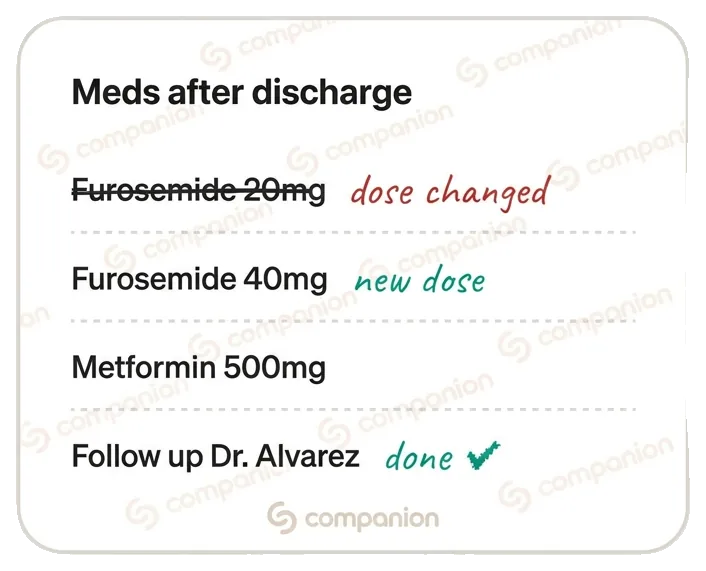
The patient is asked what any doctor added, stopped or changed, over-the-counter products included. The list goes to your clinicians for reconciliation.

What 180 older patients with several conditions bring in each month
2026 Medicare-allowed amounts, and the diagnosis codes that qualify.

Example panel
$11,903 / month
$142,841 a year · 180 patients × $66.13 (CPT 99490, national)
- CPT 99490 pays $66.13 per patient-month nationally (2026).
- Your locality moves it up or down: $60.71 in Arkansas to $83.76 in Alaska.
- Each extra 20 minutes adds CPT 99439 at $50.44.
| Condition | ICD-10 examples | Program fit |
|---|---|---|
| Dementia | F03.90, G30.9 | CCM; PIN when high-risk |
| Hypertension | I10 | CCM with a second condition |
| Type 2 diabetes | E11.9 | CCM with a second condition |
| Osteoporosis | M81.0 | CCM with a second condition |
CCM, complex CCM or APCM for older patients
Minutes in the month and who provides primary care decide the code.
| Code | Service | National 2026 |
|---|---|---|
| 99490 | CCM, first 20 minutes of clinical staff time | $66.13 |
| 99439 | CCM, each further 20 minutes | $50.44 |
| 99487 | Complex CCM, first 60 minutes | $144.29 |
| 99489 | Complex CCM, each further 30 minutes | $78.16 |
| G0557 | APCM, two or more chronic conditions | $53.78 |
| G0558 | APCM, two or more conditions, QMB | $117.24 |
Months that run long
Sixty or more minutes of clinical staff time in a month can bill as complex CCM: 99487, then 99489 per further 30 minutes. CMS bars complex plus non-complex CCM in one month, or with prolonged E/M.
When your geriatrician provides all primary care
APCM is billed monthly, with no time threshold, by the practitioner responsible for all the patient’s primary care. The same clinician cannot bill APCM and CCM for one patient in one month. We set APCM up practice by practice; see APCM vs CCM.
Advancing dementia: PIN
PIN (G0023, G0024) covers one serious, high-risk condition lasting at least 3 months that risks hospitalization, nursing home placement, functional decline or death. Advancing dementia may meet that test. PIN needs an initiating E/M visit, condition-trained staff and yearly consent renewal. See principal illness navigation.
Home health and hospice months
CCM cannot be billed in the same period as home health or hospice supervision (G0181, G0182). Flag those months before the file is approved. Planning conversations about future care are covered under advance care planning (CPT 99497).
How a geriatric patient’s month runs
For patients who see several doctors and need questions asked the same way.
You pick patients and programs
The list comes by referral form or EHR access, with CCM, complex CCM or APCM noted for each patient.
Consent, once
After your approval, the Care Advocate explains the program, one-biller rule and right to stop, then documents verbal consent.
The monthly call
Conditions, memory, falls and medicines, in the order your plan sets. Upcoming specialist and lab visits are confirmed.
A file that shows the threshold
Minutes by activity show whether the month hit 20 (99490) or 60 (99487). Your team approves it before billing.

What stays with your geriatricians
Care Advocates ask, record, confirm and route. Assessment and treatment are yours.
| Task | Your geriatric team | Companian Care Advocate |
|---|---|---|
| Medication list | Reconciles it and decides every change | Asks what other prescribers changed and records it |
| Memory and function | Assesses, diagnoses and updates the care plan | Asks the plan’s memory and function questions word for word |
| Falls | Evaluates each fall and orders therapy or equipment | Asks about falls and confirms therapy and equipment appointments |
| Specialist visits | Orders them and reads the reports | Confirms the visit date with the patient |
| Medicare claim | Bills under its own NPI through its Medicare contractor | Prepares the monthly file; never bills |
Nurse practitioners, registered nurses, licensed clinical social workers and care companions work remotely by phone and video, under your billing practitioner’s general supervision. Confirm the services agreement with your counsel. Gloria, our AI assistant, drafts documentation and pre-visit summaries; people make the calls.

Chronic care management for geriatrics practices: FAQ

Does a dementia diagnosis alone qualify a patient for CCM?
No. CMS requires two or more chronic conditions expected to last at least 12 months. They must place the patient at significant risk of death, acute exacerbation or decompensation, or functional decline. Your geriatrician decides. The rest of the program is explained in how chronic care management works for Medicare.
Can CCM continue after a hospital stay?
Yes. A patient can stay in CCM through the 30-day TCM period, as long as each minute counts once. The TCM visit itself (99495 or 99496) is your practitioner’s. Our guide to transitional care management covers the visit timing.
Can remote monitoring run with CCM?
Yes, with either remote physiologic monitoring (RPM) or remote therapeutic monitoring (RTM) in the month, not both.
What do older patients pay?
The standard Medicare Part B deductible and coinsurance. Supplemental coverage or Medicaid may pay it; the consent call explains this first.
Rates & disclosures
National amounts are 2026 Medicare Physician Fee Schedule non-facility payments at the non-QP conversion factor of $33.4009, computed from CMS RVUs. Your amount depends on your Medicare payment locality; see it in the CCM/PCM revenue calculator. Actual payment depends on participation status, place of service and cost-sharing.
Companian supplies Care Advocates and documentation to physician practices nationwide. Companian is not a medical practice and does not bill Medicare. The billing practitioner keeps the care plan, every clinical decision and the claim. Patients pay the usual Medicare Part B deductible and coinsurance for these services unless other coverage pays it.
Care management for other specialties
The same Care Advocates and monthly file, written to each specialty’s conditions.
Add care management to your geriatric practice
A 15-minute call on CCM or APCM for your patients. No patient data needed.