

Bill for social-need help
Community health integration services
Companian connects patients with food, transport, housing and benefits help, so treatment stays on track.
- No new hires. We run outreach, consent and monthly calls.
- One file a month. Nothing is billed until you approve it.
- $0 upfront. Works with your EHR, live in about a week.
$86.17* per patient, per month*CHI first 60 minutes (G0019), 2026 national rate
Get your CHI Plan
Works nationwide
Practices nationwide
You bill under your own NPI
Same Care Advocate every month
RNs, NPs, LCSWs and care companions
Monthly file approved by your team
No new hires needed



One Care AdvocateSame person, every month
Your NPI, your claimYou bill Medicare directly
Monthly billing fileYour team approves it
No upfront cost to the practice. Your team refers, we handle enrollment, outreach and documentation, and you bill Medicare under your own license. We connect with your EHR in about one week, and have worked with eClinicalWorks, Tebra and athenahealth.
Which patients qualify for CHI
CHI is Medicare’s social needs care management benefit, with three entry conditions.
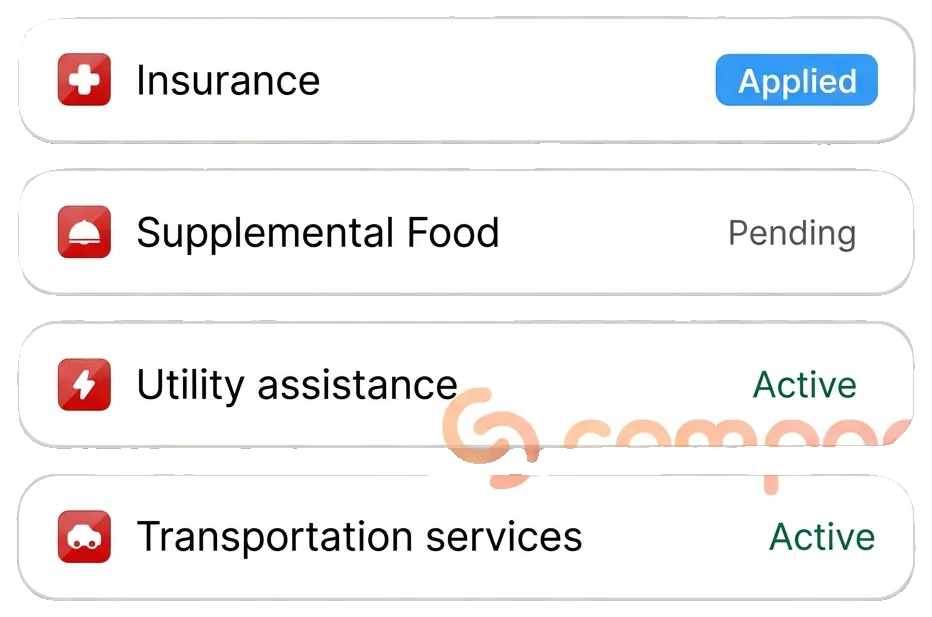
An unmet upstream driver
A social need, such as transportation, food, housing, utilities or benefits access, that blocks diagnosis or treatment.
A qualifying initiating visit
An E/M visit the billing practitioner performs, not 99211, inpatient, ED or SNF. From 2026, 90791 or health behavior assessment and intervention also count.
Consent once, in advance
Verbal or written, documented before the first billed minute. No yearly renewal.
Refer from the visit, not from a list. The practitioner who documents the need bills G0019, so each referral traces to that visit note.
| CHI requirement | Your practice | Companian |
|---|---|---|
| Initiating visit | Your practitioner records the need and how it affects care | Starts outreach after you approve the patient |
| Consent | Holds the signed or recorded consent | Explains CHI and the Part B cost-sharing, then documents consent |
| Trained personnel | Agrees in the services agreement whose time counts | Team members named there, meeting state rules or the CMS competencies |
| Supervision | General supervision by the billing practitioner | Delivers the work under that supervision, as the agreement sets out |
| Time | Approves the monthly file | Logs every activity toward 60 minutes for G0019 and each further 30 for G0022 |
| The claim | Bills Medicare and receives the payment | Does not bill Medicare |
What 60 patients with social needs bring in each month
2026 Medicare-allowed amounts, and the diagnosis codes that qualify.

Example panel
$5,170 / month
$62,042 a year · 60 patients × $86.17 (G0019, national)
- G0019 pays $86.17 for the first 60 minutes nationally (2026).
- G0022 adds each further 30 minutes.
- CHI starts from a social need found at an initiating visit.
| Condition | ICD-10 examples | Program fit |
|---|---|---|
| Housing instability | Z59.811, Z59.00 | CHI (G0019) |
| Food insecurity | Z59.41 | CHI (G0019) |
| Transportation insecurity | Z59.82 | CHI (G0019) |
| Financial insecurity | Z59.86 | CHI (G0019) |
What our care team does for a CHI patient
Assessment, connection and follow-up, each tied to the treatment it unblocks.
Person-centered assessment
What is in the way: the bus route, the pharmacy bill, the eviction notice. It shapes every call after.
Connection to community services
Matched with the agency or program that meets the need, not handed a list of phone numbers.
Follow-up on each referral
The Care Advocate checks that the help arrived, and keeps at it until the need is met or your practitioner changes course.
Report to your practitioner
What we learn goes back to your clinicians, so the plan reflects the patient’s real situation. Clinical decisions stay with them.
The care team includes registered nurses, nurse practitioners, licensed clinical social workers and care companions. Each patient keeps one Care Advocate. Gloria, our AI assistant, drafts the documentation; people make the calls.

What CHI pays in 2026
G0019 and G0022 national rates for 2026.
| Code | Service | National 2026 |
|---|---|---|
| G0019 | CHI, first 60 minutes in the calendar month | $86.17 |
| G0022 | CHI, each additional 30 minutes | $54.11 |
Your locality
Every locality’s amount is in the CCM/PCM revenue calculator. Minute-level examples are in the CHI code guide.
CHI on top of another program
CMS allows CHI alongside other care management when no time or effort is counted twice. Combined months at national rates:
| Main program that month | Add CHI? | National example |
|---|---|---|
| Chronic care management (99490) | Yes, minutes logged separately | 20 min CCM + 60 min CHI: $66.13 + $86.17 = $152.30 |
| Principal care management (99426) | Yes, minutes logged separately | 30 min PCM + 60 min CHI, each code on its own line |
| APCM (G0557) | Yes, no time or effort counted twice | $53.78 + $86.17 = $139.95 |
| Principal illness navigation (G0023) | Yes, minutes logged separately | 60 min PIN + 60 min CHI: $87.18 + $86.17 = $173.35 |
How CHI starts in your practice
Your practitioner spots the barrier. We handle the follow-through.

The need is documented
At a qualifying visit, your practitioner records the unmet need and how it affects diagnosis or treatment.
You refer the patient
By EHR access or the short referral form, from the practitioner who will bill G0019.
One consent call
After you approve outreach, the Care Advocate explains CHI and its cost to the patient and documents consent.
Your billing team signs off
One monthly file shows minutes by activity per patient. Your team approves it before billing G0019 or G0022.
Questions about community health integration services

Can community health integration be done remotely?
Yes. CMS allows CHI in facility and non-facility settings and by telecommunications technology. Our care team works only by phone and video.
Who can provide CHI?
Auxiliary personnel, including community health workers, under general supervision. They must be trained or certified under state rules, or meet the CMS competencies: communication, relationship-building, capacity-building, service coordination, advocacy, professionalism and local-resource knowledge. Have counsel confirm the supervision terms.
What else changed for CHI in 2026?
Two things beyond the wider initiating visit. CMS now says unmet upstream driver rather than social determinant of health. Marriage and family therapists and mental health counselors can bill CHI directly for mental illness services they perform.
What is the difference between CHI and PIN?
CHI targets a social barrier that blocks care. PIN helps a patient with one serious, high-risk condition follow the treatment plan, and its consent is renewed every year.
What happens when the need is resolved?
The CHI work winds down. Confirm with your Medicare contractor how a shorter month is handled, and your practitioner decides whether another program fits.
What does the patient pay?
The Medicare Part B deductible and coinsurance on each code. Supplemental or Medicaid coverage may pick it up, and the Care Advocate goes over the cost before consent.
How is Companian paid?
Your practice bills G0019 and G0022 and receives the Medicare payment. Our fee is in the services agreement and covered on the intro call.
Do you work with practices in every state?
Yes. Companian works with physician practices in all 50 states.
Rates & disclosures
National amounts are 2026 Medicare Physician Fee Schedule non-facility payments at the non-QP conversion factor of $33.4009, computed from CMS RVUs. Your amount depends on your Medicare payment locality; see it in the CCM/PCM revenue calculator. Actual payment depends on participation status, place of service and cost-sharing.
Companian supplies Care Advocates and documentation to physician practices nationwide. Companian is not a medical practice and does not bill Medicare. The billing practitioner keeps the care plan, every clinical decision and the claim. Patients pay the usual Medicare Part B deductible and coinsurance for these services unless other coverage pays it.
Add CHI for patients with social barriers
Fifteen minutes on your patients and where CHI fits. No patient information needed.