

One condition, paid monthly
Principal care management services
Companian follows your single-condition patients every month, so your practice bills PCM without new staff.
- No new hires. We run outreach, consent and monthly calls.
- One file a month. Nothing is billed until you approve it.
- $0 upfront. Works with your EHR, live in about a week.
$67.80* per patient, every month*CPT 99426, 2026 national rate
Get your PCM Plan
Works nationwide
Practices nationwide
You bill under your own NPI
Same Care Advocate every month
RNs, NPs, LCSWs and care companions
Monthly file approved by your team
No new hires needed



One Care AdvocateSame person, every month
Your NPI, your claimYou bill Medicare directly
Monthly billing fileYour team approves it
No upfront cost to the practice. Your team refers, we handle enrollment, outreach and documentation, and you bill Medicare under your own license. We connect with your EHR in about one week, and have worked with eClinicalWorks, Tebra and athenahealth.
Which patients qualify for PCM
CMS defines the patient. Your practitioner decides who is referred.
One serious, high-risk chronic condition
A single condition expected to last at least three months that places the patient at high risk.
A care plan written for that condition
Your practitioner writes and revises it. Every call stays on that one condition.
Consent before the first claim
Verbal or written, after hearing what PCM is and that Part B cost-sharing applies.
Examples include heart failure, COPD, chronic kidney disease, hard-to-control diabetes and cancer in active treatment. Your practitioner judges each patient.

What 100 single-condition patients bring in each month
2026 Medicare-allowed amounts, and the diagnosis codes that qualify.
Example panel
$6,780 / month
$81,360 a year · 100 patients × $67.80 (CPT 99426, national)
- CPT 99426 pays $67.80 national for the first 30 minutes (2026).
- CPT 99427 adds $54.11 for each further 30 minutes.
- PCM covers one serious condition expected to last 3+ months.
| Condition | ICD-10 examples | Program fit |
|---|---|---|
| Heart failure | I50.22 | PCM (99426) |
| COPD | J44.9 | PCM (99426) |
| Type 2 diabetes, uncontrolled | E11.65 | PCM (99426) |
| Rheumatoid arthritis | M06.9 | PCM (99426) |
Choosing between PCM and CCM
The care plan decides which program a patient is in.
PCM fits when
One condition drives the patient’s risk and the monthly work.
- One serious, high-risk condition
- Expected to last at least 3 months
- First billable unit: 30 minutes of clinical staff time (99426)
- Each further 30 minutes: 99427
CCM fits when
The work spans two or more chronic conditions.
- Two or more chronic conditions
- Expected to last at least 12 months, or until death
- First billable unit: 20 minutes of clinical staff time (99490)
- Each further 20 minutes: 99439
When a second serious condition takes over the calls, your practitioner can move the patient to chronic care management. The monthly file shows the new code family.

How a PCM month runs
You share the list, approve outreach and sign the file. We do the rest.
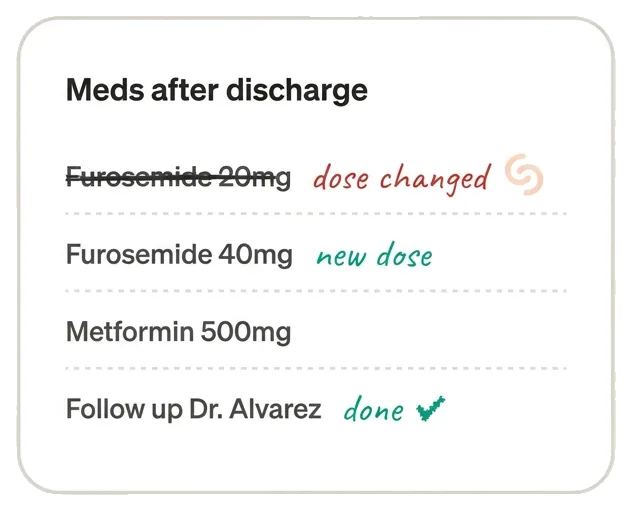
Your practitioner names the condition
Each referral, by EHR access or referral form, names the one condition the care plan covers.
Outreach and consent
After you approve outreach, the Care Advocate explains PCM and its cost-sharing, then documents verbal consent.
Calls planned around 30 minutes
PCM has no 20-minute code. Calls are planned to reach 30 minutes, and time is logged live.
One file, then the claim
Your billing team approves the month’s file. Your practice bills 99426, plus 99427 when time supports it.
What your Care Advocate handles
One person, one condition, by phone or video.
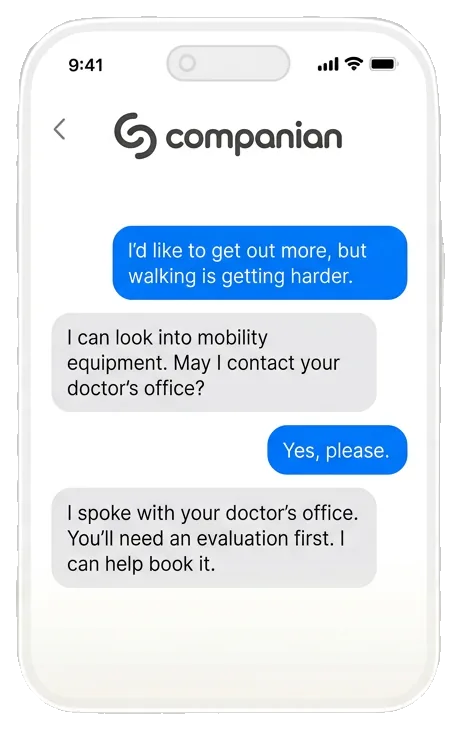
The same person each month
One Care Advocate per patient for as long as they stay. Backed by nurse practitioners, registered nurses, licensed clinical social workers and care companions.
Questions from your care plan
Symptom, reading and medication questions come from your practitioner’s plan. Every answer goes into the record. Anything new goes to your clinicians.
Visits and appointments confirmed
Visits and appointments the plan calls for are confirmed and logged in the month’s activities.
A summary before the visit
Gloria, our AI assistant, drafts the documentation and a pre-visit summary. A person reviews it and makes every call.
PCM requirements and who covers them
What CMS asks for, split between your practice and Companian.

| Requirement | Your practice | Companian |
|---|---|---|
| Choosing PCM for the patient | Your practitioner confirms one serious, high-risk condition | Works only with patients your practice refers |
| Consent | Keeps the consent record in the chart | Explains PCM and cost-sharing, then documents verbal consent and its date |
| Disease-specific care plan | Your practitioner writes and revises it | Asks its questions each month and flags changes for revision |
| 30 minutes of clinical staff time | Reviews the minutes in the monthly file | Logs minutes by activity as the calls happen |
| Supervision | The billing practitioner provides general supervision | Works under the arrangement set in the services agreement |
| The claim | Bills under its own NPI and receives the Medicare payment | Does not bill Medicare |
The monthly file lists patient reference, program and code family, month, minutes by activity, activities and consent date. Your billing team signs it off before any claim.
PCM codes and 2026 payment
Two codes for clinical staff time, two for the practitioner’s own time.
| Code | Whose time | Unit per calendar month | National 2026 |
|---|---|---|---|
| 99426 | Clinical staff | First 30 minutes | $67.80 |
| 99427 | Clinical staff | Each additional 30 minutes | $54.11 |
| 99424 | Physician or other qualified health care professional | First 30 minutes | $87.51 |
| 99425 | Physician or other qualified health care professional | Each additional 30 minutes | $61.46 |
Our Care Advocates support the clinical staff codes, 99426 and 99427.
Practices bill their Medicare Administrative Contractor, and payment varies by locality. For 99424, the 2026 national amount is $87.51; the CCM/PCM revenue calculator shows every locality for staff-time PCM. Confirm every amount in your contractor’s fee schedule lookup.
Medicare has 109 payment localities, set by state and county.
Unit rules, worked months and a sample time log are in our guide to principal care management CPT codes.
PCM in specialty practices
Specialists managing one condition between visits are a natural fit.
Cardiology
Heart failure and other cardiac conditions your cardiologist manages month to month.
Nephrology
Chronic kidney disease followed through your nephrology practice.
Endocrinology
Diabetes whose treatment your endocrinologist adjusts between visits.
Pulmonology
COPD and other chronic lung disease under your pulmonologist’s plan.
Questions about principal care management services

What are principal care management services?
Medicare care management for a patient with one serious, high-risk chronic condition. Your practice bills each calendar month with at least 30 minutes of qualifying time.
Can PCM and CCM be billed for the same patient?
Your practitioner chooses one program per patient, based on the care plan. If another practice already bills care management, check the concurrency rules in CMS MLN909188 first. Our PCM vs CCM comparison sets the two programs side by side.
What does the patient pay?
The Part B deductible, then coinsurance, as with other care management services. Supplemental coverage may pay the patient’s share.
Can an outside team provide the clinical staff time?
Yes. CMS allows clinical staff to furnish this time under the billing practitioner’s general supervision. Your services agreement sets the arrangement; confirm it with your counsel.
What happens in a month under 30 minutes?
No PCM claim for that month. The minutes still appear in the monthly file, so your team sees the month as it happened.
How is PCM different from principal illness navigation?
Principal illness navigation (G0023, G0024) helps the patient follow the treatment plan, while PCM manages the condition month to month. Its first unit is 60 minutes, and CMS allows it alongside care management when no time is counted twice.
How is Companian paid?
Companian’s fee is walked through on the intro call. Your practice bills Medicare and keeps the payment.
Rates & disclosures
National amounts are 2026 Medicare Physician Fee Schedule non-facility payments at the non-QP conversion factor of $33.4009, computed from CMS RVUs. Your amount depends on your Medicare payment locality; see it in the CCM/PCM revenue calculator. Actual payment depends on participation status, place of service and cost-sharing.
Companian supplies Care Advocates and documentation to physician practices nationwide. Companian is not a medical practice and does not bill Medicare. The billing practitioner keeps the care plan, every clinical decision and the claim. Patients pay the usual Medicare Part B deductible and coinsurance for these services unless other coverage pays it.
Start PCM without hiring
Fifteen minutes on your likely PCM patients. No patient details needed.